Neuro-Symbolic AI for Enterprise Decisions
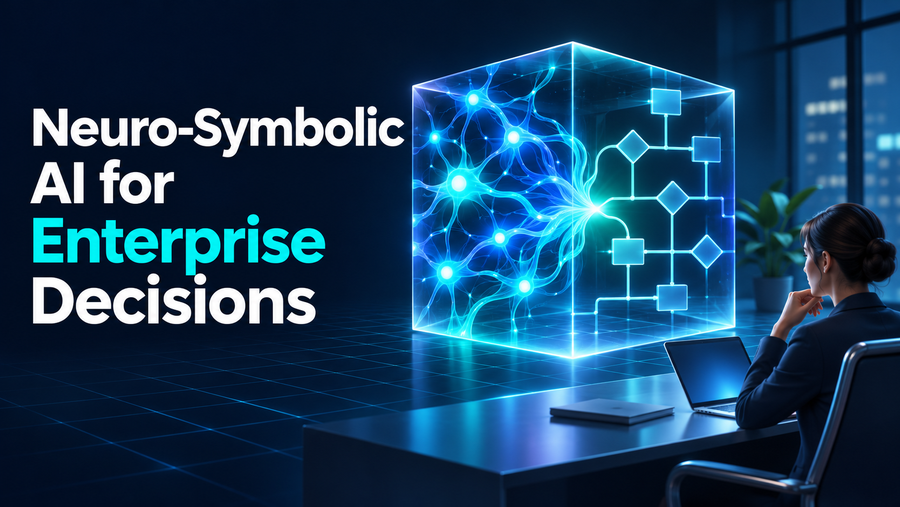
For consequential enterprise decisions, PathWay's neuro-symbolic approach is better than leaving essential business reasoning to the discretion of a large language model (LLM). It combines the flexibility of neural AI with explicit business rules and causal models executed directly in solution code.
Required checks become part of how the application works. Experts can examine the causal assumptions and test the decision logic independently of the LLM. This gives an enterprise greater control over decisions for which it must take responsibility.
Understanding neural and symbolic AI
Neural AI learns from examples. A neural network is a mathematical model trained to recognize patterns in data. Large language models are one example: their training enables them to interpret and generate language, including wording they have never seen before. An LLM could read a supplier's quotation and extract the proposed price and delivery terms, despite differences in format and phrasing. The learned knowledge is distributed throughout the model, so it is difficult to inspect or amend as individual business rules.
Symbolic AI works with explicitly represented knowledge. A "symbol" stands for something meaningful, such as a supplier, an order or an approval limit. The system uses stated relationships and rules to reason about those things. For example, it can apply the rule that purchases above a specified value require finance approval. Experts can inspect that rule and change it when policy changes. Symbolic methods also include richer representations, such as knowledge graphs and causal models that describe how actions are expected to affect outcomes.
Neuro-symbolic AI brings the two together. In the purchasing example, the neural component interprets the quotation; the symbolic component checks the extracted facts against the approval policy; and the LLM can explain the result to the user. A well-designed combination uses neural AI to handle the variability of human languages while explicit rules and models ground the reasoning to a mathematical basis. There are several ways to connect these components, and that design choice matters. [1]
Why giving an LLM tools is not enough
OpenAI and Anthropic enable their models to generate code and call existing tools. In a model-led workflow, the LLM decides which operations to perform and uses the results to construct its answer. This makes a general-purpose assistant flexible, but leaves the choice of operations dependent on the model. [2][3][4]
A program can execute correctly while using an unsuitable equation, overlooking a business constraint or relying on an unsupported causal assumption. Access to tools therefore does not, by itself, establish that the right reasoning has been applied.
PathWay makes the required checks and causal analysis part of the application workflow. OpenAI and Claude models can supply neural capabilities within that architecture. The advantage comes from combining those capabilities with business-specific knowledge and a defined decision process.
Representing the business explicitly
A PathWay solution starts with a defined business problem and the decisions required to address it. We identify the information, expertise and relationships needed to improve those decisions.
A knowledge graph can connect equipment to production lines, maintenance events, suppliers and operating procedures. Business rules specify which actions are permitted and which conditions require escalation. Causal models represent how changes in controllable factors are expected to affect outcomes.
Each contributes something different: the graph establishes context, rules determine eligibility, and causal models evaluate consequences. Gary Marcus has highlighted code-using assistants as examples of the broader neuro-symbolic approach. [5] PathWay applies that principle to the business itself, with domain knowledge that directly contributes to the decision.
Executing rules and models in the solution
In the general PathWay pattern, business rules and causal models execute directly in solution code. Their use can be a required step in the workflow, without depending on an LLM choosing to invoke them.
Supplying descriptions of those rules or models in a prompt does not provide the same control.
Neural AI can also help write the solution code. Generating code during development, then reviewing and testing it, is different from generating decision logic afresh during use. Once deployed, the application controls how approved logic is applied.
This makes the components independently testable. A rule can be checked against boundary conditions. A causal model can be evaluated against evidence and its assumptions reviewed with subject matter experts. The explanation presented to a user can be checked against the results actually produced.
Direct execution does not make a rule correct or a model accurate by definition. It makes their contribution explicit, so that errors can be traced and corrected in the component responsible.
How causal models contribute to symbolic reasoning
An explicit causal model represents meaningful variables, causal relationships and mechanisms. It supports questions such as what would happen to output, cost or failure risk if an operating policy changed.
In a structural causal model, an intervention has a defined mathematical meaning: it changes the mechanism determining a variable, allowing the consequences to be evaluated through the rest of the model under its assumptions. This relationship between graphs, equations and interventions is central to Judea Pearl's account of causal reasoning. [6]
A causal model may contain parameters estimated from data and express uncertainty through probability distributions. Neither feature removes its explicit structure or the defined meaning of its operations. Symbolic reasoning can incorporate uncertainty; it does not have to produce a deterministic answer.
These properties make causal models a substantive part of the symbolic architecture. They supply an executable account of how an intervention is expected to affect the business, with assumptions that experts can inspect.
Pearl on causal models in the era of LLMs
In his published preface to the second edition of The Book of Why, Pearl describes causal modeling and machine learning as complementary. Causal assumptions determine which quantities must be estimated to answer a question; machine learning helps estimate those quantities from data. [7]
He also explains that human-authored training text already contains causal knowledge. An LLM's ability to answer some causal questions does not therefore establish that it has a reliable, explicit causal representation. [7]
His discussion of worldviews and narratives makes a related point: people can interpret the same evidence differently because they bring different models of how the world works. Formalizing those models helps expose assumptions and identify evidence that could challenge them. [7] For enterprise decisions, that provides a practical basis for examining disagreements between experts.
A maintenance decision in practice
Consider an illustrative solution supporting an engineer who must decide whether to inspect a machine immediately, reduce its operating load or continue until a planned shutdown.
The neural component interprets maintenance notes and helps identify relevant observations. A knowledge graph connects the machine to its components, previous work, production commitments, and applicable procedures. Extracted information can be checked against authoritative records before it enters the decision process.
The solution executes rules to determine which options are permitted. An overdue mandatory inspection may eliminate continued operation from consideration. A requirement for specialist approval determines who needs to review a proposed action.
For the remaining options, a causal model can estimate how reducing load would affect outcomes, provided it represents the relevant mechanisms and has adequate supporting evidence. The application combines those estimates with production and maintenance costs to compare the alternatives.
The LLM helps explain the comparison and lets the engineer ask follow-up questions. The engineer reviews the evidence, checks whether the circumstances fit the model's assumptions and makes the final decision.
Making expertise available across the business
Experienced employees know which conditions matter and which apparent relationships are misleading. Capturing that expertise in graphs, rules and models makes it available more consistently across a team.
A well-designed implementation can retain the evidence, rule and model versions, assumptions and results behind a recommendation. That gives reviewers a record of the decision process to examine alongside the generated explanation.
The ambition is to raise the quality and speed of decisions while keeping people responsible for the final judgment.
A better approach within a defined business scope
Our claim applies to solutions for specific business situations. We do not yet have a general purpose neuro-symbolic AI platform. Each solution's rules and causal models are developed or selected for particular decisions, operating conditions and assumptions, with subject matter expertise central to that work.
The method and some components can be reused. A model developed for one factory may provide a starting point for another, but equipment, operating limits and causal mechanisms can differ. Reuse still requires adaptation and validation in the new setting.
Within that defined scope, PathWay's approach is better because it gives the enterprise explicit control over the reasoning that matters. The business can specify the checks that must run, examine the assumptions behind an intervention estimate and review the evidence supporting a recommendation. Those capabilities are essential to turning powerful neural models into dependable decision support.
References
- Vaishak Belle and Gary Marcus, The Future Is Neuro-Symbolic: Where Has It Been, and Where Is It Going?, Proceedings of the AAAI Conference on Artificial Intelligence, 2026.
- OpenAI, Code Interpreter.
- Anthropic, Tool use with Claude.
- OpenAI, Function calling, including the tool calling workflow and tool-choice controls.
- Gary Marcus, The biggest advance in AI since the LLM, April 2026.
- Judea Pearl, The Art and Science of Causal Effect, Part 2.
- Judea Pearl, Preface to the Second Edition of The Book of Why, Technical Report R-536, October 2025.