AI Agents and the Knowledge that Goes Home Each Night
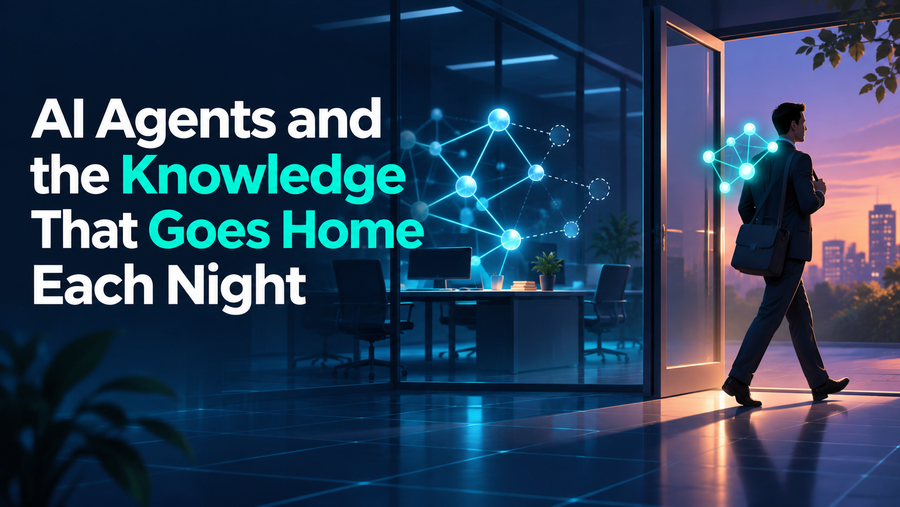
Much of a company's most valuable knowledge goes home each night. Sometimes the person carrying it retires, resigns or joins a competitor. The knowledge may never come back.
An experienced employee leaves and apparently straightforward work becomes unexpectedly difficult. The procedures, databases and years of records are still there. What is missing is the understanding that made them useful.
This is a fundamental challenge for claims that swarms of AI agents will replace employees. How will those agents acquire the knowledge that experienced people bring to the job?
The DeepMind Institute's essay, The Economics of Intelligence argues that better agent coordination could transform the scale and structure of businesses. It acknowledges tacit knowledge and the difficulty of communicating it. But before agents can share that knowledge, they need to acquire it and learn when to apply it.
A thousand agents working from the same incomplete account of a business still have an incomplete account of the business.
The records do not contain the whole job
Some knowledge is simply undocumented. A supplier's delivery estimate needs checking with a particular person. A maintenance procedure assumes a modification that only some machines have. Someone knows these things, but the system does not.
Other expertise is harder to explain. An engineer recognizes that a reading which looks normal is wrong for these operating conditions. A manager knows whose reassurance needs further investigation and has the trust required to uncover an uncomfortable problem.
Consider an operations manager who spots a problem in a routine schedule, makes a quiet adjustment and prevents a disruption. The system records a successful day. It may contain no explanation of the warning they noticed or the alternative they rejected.
An agent could reproduce the visible activity while missing the judgment that made it work. The employee's most valuable contribution may be the problem that never happened.
Management adds more than coordination
Good managers decide which evidence deserves weight, challenge assumptions and reconcile competing priorities. Finance may want less inventory while operations want more resilience. Faster communication does not settle that trade-off.
Some organizational friction is useful. It exposes weak assumptions before they become expensive commitments. Giving agents a common objective may simplify coordination, but that objective already contains choices about whose interests count and which risks are acceptable.
Those choices require judgment and accountability. Showing that agents can execute an objective efficiently does not establish that it was the right objective, or that the resulting decision was sound.
Knowledge must keep being renewed
AI can help preserve more of what employees know. Working with experts on real decisions, examining exceptions and asking why alternatives were rejected can turn experience into knowledge others can use. Research on AI-assisted customer support illustrates the potential to help less experienced employees, while people retain responsibility for the work.
But capturing today's expertise is only the beginning. Equipment changes, customers behave suddenly differently, and new failure modes emerge. A business must keep learning. Replacing experienced people risks weakening the process that creates new knowledge, even if some of their existing knowledge has been retained.
People also need a reason to contribute. Asking employees to share years of experience so they can be made redundant creates an obvious tension. Helping them do better work gives knowledge sharing a more constructive purpose.
Acquiring, validating and maintaining organizational knowledge takes continuing effort. That effort belongs in the business case for agents.
How Geminos turns knowledge into better decisions
At Geminos, we build AI around people and the decisions they make. Our goal is to reduce tedious investigation, preserve valuable expertise, and raise the average quality of decisions across the business.
KnowledgeWay connects enterprise knowledge with its business context. Expert contributions help make lessons reusable: what happened, under which conditions and what evidence supports the conclusion. Human curation keeps that knowledge relevant as the business changes.
In the scheduling example, capturing the dependency behind an experienced manager's intervention could help another employee spot the same risk. More people can benefit from knowledge that previously depended on one colleague being available.
Business rules express established constraints and practices. CauseWay brings causal models into the analysis of interventions, and agents can now invoke those models to explore what different actions are expected to change. Experts can examine the assumptions and challenge the recommendation.
Human involvement is permanent. The person responsible for a consequential decision needs the evidence, time and authority to question the analysis, request more work or reject it. Their experience also helps improve the knowledge available for the next decision.
Customers can gain substantial value by helping more employees make better decisions, with less effort and less dependence on a handful of experts. Complete employee replacement is not a prerequisite.
Measure what matters to the business
This is why the industry's emphasis on exponential improvement misses the business test. Today's models produce better drafts, handle more context and need less prompting. Yet last year's models already helped me write useful blog posts. My overall output has not improved exponentially, because producing a draft was only part of the work.
The same applies to coding and business analysis. Faster progress on a task does not establish an equivalent improvement in the completed result.
Businesses need better decisions, reached sooner, with less investigation and rework. They need to see improved outcomes from acting on those decisions.
Before claiming that an agent swarm can replace the people whose knowledge goes home each night, show how it acquires that knowledge, applies it reliably and keeps it current. That is a much more demanding test than faster task completion, and a much more useful one.