Why Enterprise AI Depends on More Than the Model
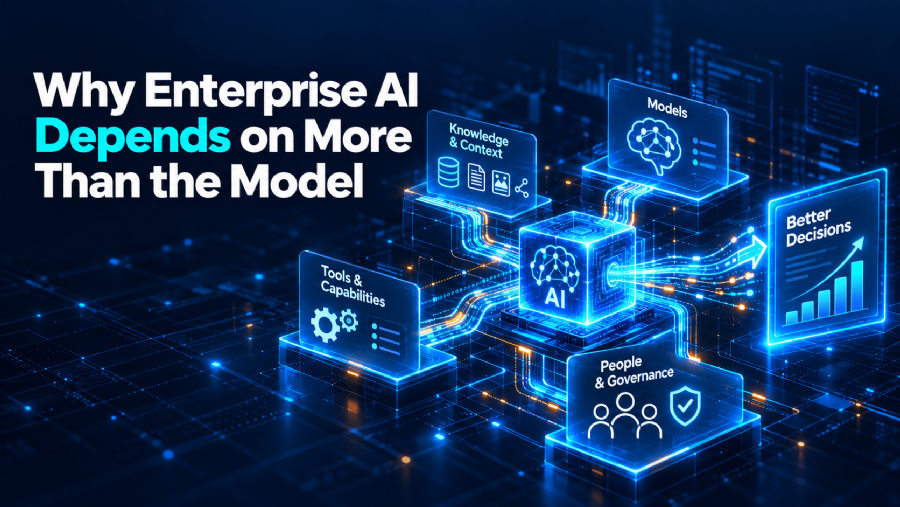
Why shared knowledge, specialized capabilities and accountable people matter to enterprise AI
Much of the AI industry's attention goes to the next model: how it reasons, how quickly it responds and which benchmark it has topped. Those advances matter. At Geminos, we use increasingly capable models to help solve business problems.
But customers experience the complete application. They need it to understand their information, work with their existing systems, support the people making decisions and deliver an outcome worth paying for. The model is one contributor to that experience. The architecture determines how the contributors work together.
That is why a new DeepMind Institute essay caught my attention. “Artificial symbiotic intelligence: Agents, AGI and the orchestration of many minds,” by Benjamin Bratton, Blaise Agüera y Arcas and James Manyika, explores intelligence as a property of interacting systems.[1] Its implications extend well beyond debates about when AGI might arrive. It raises questions that enterprise application builders face today.
The argument in the essay
The authors suggest that advanced AI may develop through combinations of models, tools, shared knowledge, institutions and people. Their central claim is that the organization of those parts can matter as much as the capabilities of any individual participant.
They describe agents as assemblies of capabilities and argue for structures with defined roles, procedures and feedback. On this view, useful collective intelligence depends on the arrangements through which participants communicate, contribute and make decisions. They also anticipate interfaces that help people manage several specialized contributions, and favor an approach in which alignment develops through interactions among agents, people and institutions.[1]
This is a conceptual argument about a possible future. It does not demonstrate that large agent collectives can reliably run a business. My interest is in what its architectural perspective can teach us about useful enterprise applications now.
My starting point for enterprise customers is firmer: authority, permitted actions and responsibility for changing the rules must be defined before deployment. Businesses cannot leave those responsibilities to emerge during operation.
Start with the decision the customer needs to make
Consider an illustrative equipment maintenance decision. The team needs to determine whether a recurring problem calls for another inspection, a change in operating practice or replacement of a component.
Several kinds of work contribute to that decision. Someone needs to reconcile the equipment identifiers across systems. Maintenance history must be connected to operating conditions. Engineers' observations need to be interpreted in context. A prediction may help estimate future failure risk. A causal analysis may help investigate the likely effect of an intervention, subject to its assumptions and the available data. Finally, a responsible person must decide what to do.
Those contributions have different standards of evidence and different failure modes. Asking a language model to produce one comprehensive answer does not remove the need to perform them properly.
At Geminos, we begin by identifying the decision, its owner, the information required and the outcome the customer wants to improve. That gives us a basis for choosing the capabilities and workflow the application actually needs.
Sometimes a simple retrieval and review workflow is sufficient. Other situations justify several analytical methods and specialist tasks. Complexity has to earn its place in the business case.
KnowledgeWay gives the work a common context
A practical difficulty in enterprise AI is that different systems describe the same business in different ways.
A component can have one identifier in a maintenance system and another in an engineer's report. An incident record may use a local name for a location. A useful observation may be buried in a document written years before the current investigation.
KnowledgeWay addresses this through an enterprise knowledge graph connecting information to the assets, people, events and relationships that give it business meaning. Subject matter experts help shape that knowledge. The aim is to make relevant context available across applications and investigations.
That matters when several analytical capabilities contribute to the same decision. Their outputs need to refer to the same asset, time period and operating conditions. Without that common context, a technically correct result can answer the wrong business question.
It also matters when specialists disagree. A shared view of the evidence can help establish whether they are interpreting the same observations differently or working from different information altogether.
For customers, this makes the investment in knowledge useful beyond one application. A carefully established asset relationship or business definition can support subsequent investigations, searches and solutions. Reuse still requires checking that the context fits the new purpose, but the organization can build on work it has already done.
Specialized capabilities need clear responsibilities
There are good reasons to combine different forms of AI and conventional software.
A language model can help interpret a report or express a question. A database query can retrieve an exact set of records. A predictive model can estimate an outcome. CauseWay supports analysis of causal relationships and possible interventions. Business rules capture established constraints and practices. Each contributes something different.
ArchWay provides the reference architecture for bringing appropriate capabilities together around a customer workflow. Agents can now invoke causal models, bringing causal analysis directly into an agent-supported investigation. The tools and integrations available to an agent are specified for each application; agent use of business-rule services remains an area of research.
That distinction is important. The architectural ambition can be broad while the authority granted to a particular component remains narrow and explicit.
For the maintenance example, an agent could assemble the relevant evidence and invoke an appropriate causal model to investigate a proposed intervention. The responsible person would review the findings, the model's assumptions and the supporting evidence before deciding on the response. The causal analysis contributes a distinct analytical basis to that decision, while the language model helps make its results accessible.
The value of combining capabilities comes from assigning useful roles and checking the handoffs between them.
People contribute knowledge as well as approval
Human involvement is sometimes described as a final button press after AI has completed the important work. That misses much of the value experienced employees contribute.
An engineer may know that the equipment was operating outside its usual range. An investigator may recognize that two apparently independent reports were copied from the same original account. A planner may understand why a recommendation that looks efficient on paper would create an unacceptable operational disruption.
These contributions should influence the investigation while it is happening. They help refine the question, challenge assumptions and establish what additional evidence is worth seeking.
At Geminos, our goal is to make the quality, context and discipline of the best decision-makers available more widely. Knowledge graphs and business rules help capture parts of that expertise. AI can help people find and apply it. The accountable person retains the consequential decision.
That is a useful interpretation of human and artificial intelligence working together: each contributes where it can improve the result, with clear responsibility for the outcome.
PathWay makes the architecture repeatable
An architectural diagram has limited value until a team can turn it into working applications and maintain them.
PathWay is our method for designing, building, validating and evolving solutions within ArchWay. It combines explicit requirements, reusable patterns and documented engineering knowledge with AI-assisted development. Tests, model evaluations and expert review provide evidence about how a solution behaves for its intended purpose.
The discipline matters because enterprise scale includes the number of applications an organization can successfully deliver and support. One useful solution should leave behind assets that make the next easier: data mappings, knowledge definitions, integration components, delivery skills and clearer operating responsibilities.
That creates a different investment pattern from repeatedly commissioning isolated AI projects. Customers can build a growing foundation, while each new application is still assessed against its own requirements.
Judge the complete system by the customer's outcome
For customers, the practical questions are whether investigations take less time, whether evidence is easier to inspect, whether decisions improve and whether the organization preserves what it learns.
There is also a cost question. A complex workflow can consume more model calls, more engineering effort and more review time than its benefits justify. The architecture should make those trade-offs visible so that teams can simplify where appropriate and invest where the result warrants it.
I see the DeepMind essay as a useful prompt to examine the whole system around AI. The practical work remains ours: define responsibilities, manage information quality and demonstrate value in each application.
Geminos is building around those practical requirements. KnowledgeWay supplies connected business context. CauseWay adds a distinct analytical capability. ArchWay structures the solution, and PathWay gives us a repeatable way to deliver it with customers.
As models improve, that foundation lets us put their capabilities to work where they help. The customer gains better tools for important decisions and an enterprise that becomes more capable with each successful application.
Source
- Benjamin Bratton, Blaise Agüera y Arcas and James Manyika, “Artificial symbiotic intelligence: Agents, AGI and the orchestration of many minds”, DeepMind Institute. Accessed September 24, 2026. The enterprise examples and Geminos implications above are my interpretation; the essay does not evaluate Geminos products.