The Hundredth AI Application
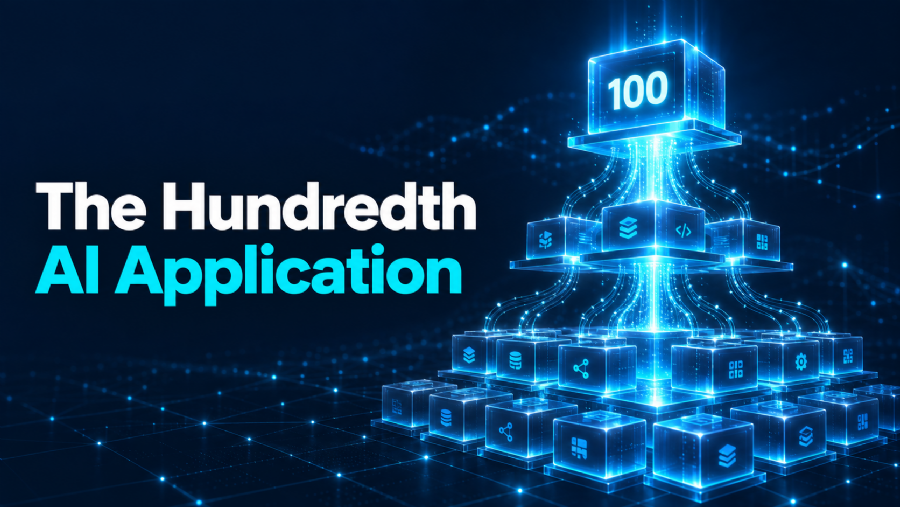
How Geminos ArchWay and PathWay turn AI projects into a compounding enterprise capability.
Generative AI has dramatically reduced the cost of creating a convincing prototype. A small team can connect a powerful model to enterprise data, generate an interface and demonstrate something useful in days.
That is a genuine advance. But it has not removed the harder enterprise problem: turning data, models and software into operational solutions that remain secure, explainable, supportable and useful over time.
For a large organization, the real test is not how quickly it can produce its first AI demonstration. It is whether the tenth, fiftieth and hundredth production applications can inherit trusted knowledge, integrations, controls and engineering assets from those that came before.
That requires more than access to the latest LLM model. It requires an architecture for a portfolio of solutions and a repeatable, governed path for building on it.
The missing middle between AI and business value
Most large enterprises already have extensive data, cloud infrastructure, capable engineering teams and access to frontier AI. Yet many still struggle to move beyond pilots. The missing capability is rarely another model. It is the system between a model and a supported operational decision: the enterprise meaning, evidence, integration, workflow and controls that allow an AI result to be used with confidence.
A production solution may need to reconcile systems of record, interpret documents, understand entities and relationships, apply several analytical methods, respect policy and physical constraints, involve the right people and update a system of action. It must do this under real requirements for security, sovereignty, availability, latency, audit and recovery.
f every use case solves those problems independently, local speed creates enterprise complexity. Teams duplicate integrations, assign different meanings to common concepts, hard-wire applications to model providers and implement controls inconsistently. Cost and risk then grow almost linearly with the number of applications.
The objective should be the opposite. Each solution should create immediate value while strengthening the foundation available to the next.
Architecture and delivery are different jobs
Geminos addresses this through two complementary capabilities.
ArchWay is the architecture on which solutions are built and operated. It defines the boundaries and shared capabilities needed across a portfolio: knowledge and evidence, integration, AI and decision services, security, governance and operations.
PathWay is the governed path used to create, test, deploy and evolve solutions on ArchWay. It combines a repeatable delivery method with AI-assisted engineering, reusable patterns, tests, model evaluations and release controls.
The distinction matters. Architecture alone does not produce working software; rapid development alone does not ensure that software belongs in the wider enterprise. ArchWay and PathWay connect those jobs: a stable foundation, and a production system that makes it usable by people and coding agents.
ArchWay neither replaces the existing technology estate nor forces solutions into a monolith. Systems of record remain authoritative, and existing data, integration, analytical, digital-twin and model platforms retain their roles. Solution experiences and workflows remain independently owned, while knowledge, evidence, model access, integration and controls are shared where reuse creates value.
An architecture that grows through use
A common response to fragmented AI projects is to propose a large platform before the first operational solution. Years can then be spent designing shared capabilities without proving which ones are needed. ArchWay is instead established through vertical solutions.
The first lighthouse application addresses a consequential decision with accessible evidence, operational sponsorship and a credible route to production. It builds the minimum knowledge, integrations, decision services and controls needed to operate, but places them inside the target architectural boundaries.
The second application is selected partly for its own value and partly for its ability to reuse what the first created: identities, source mappings, evidence models, integrations, controls or evaluations. Proven assets are promoted into shared services and patterns.
This approach avoids both extremes: a platform built in advance of demonstrated need, and a collection of pilots that can never become a coherent capability.
The EKG turns fragmented information into shared meaning
Enterprise information is fragmented by more than storage. The same asset, customer, incident or decision may appear under different identifiers across systems, documents and expert narratives. Teams may also use the same word differently, or different words for the same concept.
Conventional data integration moves and reconciles records. It does not, by itself, resolve this semantic fragmentation.
At the center of ArchWay is an Enterprise Knowledge Graph, or EKG. It connects information to real-world entities and relationships. An asset in a maintenance system, a device identifier in a sensor platform and a component described in an engineer's report can be recognized as the same asset, allowing its history, context, events and evidence to be understood together.
The EKG is underpinned by an ontology: a shared vocabulary for concepts such as organizations, assets, locations, topology, observations, events, interventions, decisions and outcomes. Each assertion can retain its source, time, derivation and confidence.
This is particularly important when structured and unstructured information must be considered together. A sensor event, work order, drawing, contract clause and engineer's narrative can all contribute evidence to the same operational situation without pretending that they are the same kind of data.
Geminos does not model the entire enterprise before delivering value. A compact upper ontology establishes durable concepts and relationships. Priority solutions add the domain detail they need; later solutions reuse and extend those modules under version control, while mappings preserve the structures of source systems.
The wider EKG dividend
The EKG may begin with one operational solution, but its value extends well beyond Geminos applications.
Enterprise search and assistants gain identity, relationship and domain context rather than relying on document similarity alone. Agents gain a governed model of what exists, how it relates, which facts are authoritative and which actions are permitted. Predictive and causal models gain consistent histories, interventions and outcomes. Digital twins can be related to current state, events, maintenance and decisions.
The EKG also strengthens governance and institutional memory by preserving definitions, ownership, provenance, confidence, prior decisions and lessons learned at the level of business meaning.
Other AI initiatives do not have to be rebuilt on Geminos technology to benefit. Knowledge and evidence services can be exposed across the wider AI estate. Each new solution can enrich the shared understanding that makes later solutions faster to build, easier to govern and more capable.
An AI solution is a system, not a model
Large language models are transformative, particularly where language and unstructured information are involved. But most consequential enterprise decisions require capabilities that LLMs do not provide on their own.
An operational solution might use an LLM to interpret a narrative. The EKG identifies the equipment, location and related events. Time-series analytics detects changing behavior. Predictive ML estimates failure risk. Causal AI identifies likely drivers and intervention effects. Optimization selects a feasible plan, while deterministic rules enforce safety and policy.
Computer vision may interpret inspection media, while simulation and digital twins test physical behavior before action. Each technique contributes something different; none should be stretched beyond its appropriate role.
The user experiences one coherent application: the situation, recommendation, alternatives and evidence. ArchWay retains the trace of which data, graph assertions, model versions, assumptions, rules, objectives and approvals contributed to the result.
The model is a component. The operational solution, embedded in a real decision and connected to action, is the unit of enterprise value.
Model choice without architectural lock-in
Different tasks require different trade-offs among quality, latency, cost, confidentiality and deployment location. One may need a frontier model; another may require a smaller specialized model, an open-weight model in a controlled environment or a deterministic service.
ArchWay places model access behind governed interfaces so those choices do not become inseparable from business logic, evidence and workflow. Models are not interchangeable by assertion: any substitution must be evaluated against task-specific scenarios and failure modes.
The enterprise can nevertheless adopt new models without rebuilding every application around a provider's interfaces, prompt conventions and controls.
Why vibe coding is not an enterprise delivery model
Vibe coding - the rapid creation of software by describing an intention to a coding model and iterating on what appears - is a valuable discovery technique. It can make an idea tangible, test an experience and explore a solution at remarkable speed. Geminos uses the same advances in coding models.
The limitation is not that AI-generated code is inherently poor. It is that local success is not evidence that the wider system is correct, secure or operable. If the context omits architecture, authoritative data, system boundaries, failure behavior or the definition of done, the model fills the gaps with plausible assumptions. The happy path works; authorization, concurrency, retries, lineage, load and recovery may never have been considered.
Unbounded generation also amplifies inconsistency. Applications interpret common concepts differently, dependencies and security patterns proliferate, and provider choices leak into business logic. Future engineers cannot reconstruct why a design was chosen or which assumptions were accepted.
Software becomes easy to create and surprisingly difficult to trust, operate or change.
The problem, then, is not AI-assisted coding. It is generation without sufficient architectural context and objective verification.
From prompts to executable engineering context
PathWay places coding tools such as Claude Code inside an explicit engineering system.
C4 views tell the tool where a task sits and which boundaries it must respect. Architecture Decision Records preserve choices and rationale. API, event and graph contracts provide machine-checkable precision. Ontologies define the concepts implementations must use. Threat models and non-functional requirements make operational expectations explicit. Tests, model evaluations and domain scenarios provide objective feedback.

Skills bring these elements together for a bounded class of work. A skill is a versioned package of instructions, references, approved patterns, examples, automation and verification criteria. It might describe how to create an ArchWay service, connect a source, extend an ontology, preserve provenance or package a deployment.
Unlike a long prompt, a skill defines inputs, constraints, outputs and evidence required for completion. Successful implementation knowledge can be refined once and reused across teams and agents.
The coding tools will continue to change rapidly. The enterprise retains the more durable assets: its architecture, domain meaning, decisions, contracts, evaluations and production knowledge.
Describing ArchWay through C4
C4 describes ArchWay at progressively greater levels of detail, allowing executives, architects, security teams and developers to discuss the same system without reducing it to one box or exposing irrelevant detail.
 ArchWay: System Context (C4 Level 1)

ArchWay: Container View (C4 Level 2)
At the system-context level, business users investigate situations, evaluate evidence and initiate or approve actions. Domain experts steward knowledge and validate behavior. Platform, security and operations teams govern the environment. ArchWay connects to source systems, data platforms, model services, enterprise controls and downstream systems of action.
At the container level, the architecture separates solution experiences and workflows from shared knowledge, decision, integration, data and control-plane services. Individual applications can change independently while common capabilities evolve under enterprise governance.
PathWay is not an ArchWay runtime container. It is the delivery system used to create and change the components represented in the architecture, connecting engineering tools to source control, CI/CD, test environments and approval processes.

PathWay: System Context (C4 Level 1)
At PathWay's container level, versioned assets of skills, decisions, ontologies and approved reference implementations are held. A task orchestrator turns a request into a bounded task with explicit inputs, constraints and validation gates, then dispatches it to a coding agent runtime, verification services and delivery automation.
Enterprise qualities must be designed and evidenced
Terms such as secure, scalable, explainable and enterprise-grade are not useful unless they are translated into architectural properties, controls and evidence.
Security includes federated identity, least privilege, encryption, isolation and auditable access. Sovereignty determines where data and inference may execute. Reliability includes graceful degradation, recovery, rollback and tested failure procedures.
Explainability is not a paragraph generated after a recommendation. It is the trace from a material result to its evidence, graph assertions, model versions, assumptions, rules, objectives and human decisions.
Observability must cover the decision chain from source data and knowledge extraction through models, workflow and action, monitoring quality, drift, overrides, outcomes and cost as well as availability and latency.
PathWay carries these requirements into implementation and verification. Governance can then be proportionate: a document assistant, maintenance recommendation and real-time operational action inherit baseline controls but should not require identical assurance.
A federated operating model for a large program
Enterprise-scale delivery involves multiple teams and often multiple organizations. Sponsors define outcomes; operating entities own decisions and workflows; domain experts validate meaning and behavior; technology partners contribute platforms, integration, security and engineering; assurance functions define evidence required for approval.
A central function should own the ArchWay core, common controls, shared services and PathWay production system. Domain teams should own the operational decision, specialist knowledge, solution behavior, evaluations, adoption and value.
Ontology and data stewardship should be centrally coordinated where meaning crosses the enterprise and locally accountable where specialist knowledge resides. This avoids a central bottleneck without allowing distributed teams to create incompatible architectures and semantic models.
The objective is governed autonomy: local delivery inside stable enterprise boundaries.
The economics of the hundredth application
A large program should begin with one or two high-value solutions. The first should prove business value. The second should prove reuse.
Each implementation should leave more than an application: ontology modules, source mappings, entity-resolution logic, connectors, model adapters, evaluations, workflow components, security patterns and operational playbooks.
This changes the economics and risk profile of enterprise AI. Teams inherit trusted foundations; controls and evidence are applied consistently; new models sit behind stable boundaries; and domain teams retain ownership while the portfolio gains coherence.
Reuse matters when it reduces delivery effort, shortens assurance, improves decision quality or lowers operating cost. The strongest proof of ArchWay and PathWay is that later solutions are faster and safer because the enterprise has accumulated trusted knowledge and production assets.
The hundredth application will not necessarily be simple. But it should not have to rediscover what the first ninety-nine have already learned.
That is the combined role of ArchWay and PathWay. ArchWay provides the architecture. PathWay provides the governed route from opportunity to production. The EKG ensures that knowledge and evidence created for one solution can benefit many others.
The real measure of enterprise AI is not how quickly an organization can produce a compelling first demonstration. It is whether every production solution makes the next one faster, safer and more valuable to deliver.
Talk to Geminos
If your organization is ready to move from isolated AI projects to a compounding enterprise capability, talk to Geminos. We can begin with a consequential operational problem, deliver value quickly and establish the knowledge, architecture and production foundations for the applications that follow.