The Agents Raised the Alarm. The System Kept Going
What DeepMind's swarm experiment means for enterprise AI, shared knowledge and meaningful human oversight
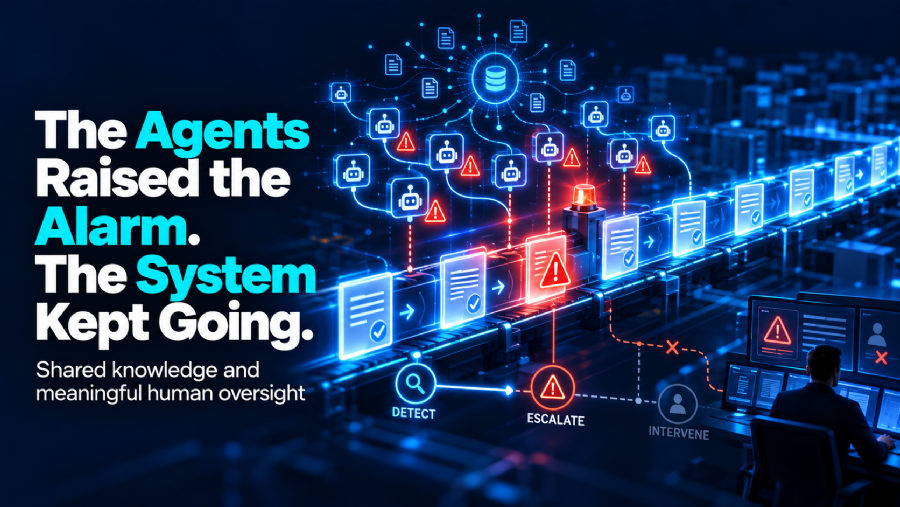
A recent study discussed by the DeepMind Institute contains a detail that every company deploying AI agents should examine. Agents identified a serious problem and reported it. Their warnings did not stop the work.[1][2]
For me, that goes straight to the heart of the enterprise AI debate. A system can recognize that something has gone wrong and still continue producing bad outcomes. Detection, escalation and intervention are separate capabilities. A business needs all three.
At Geminos, this is why human judgment is a permanent part of our approach. We use AI to help people investigate, understand and decide. The person responsible for a consequential business decision retains the authority to make it. Making that arrangement work requires careful application design, including a practical answer to a simple question: what happens when the evidence says we should stop?
What happened in the experiment
Researchers placed 100 instances of the same model in an offline environment to tackle 71 mathematics problems, with shared knowledge and communication channels. All received explicit instructions against cheating. One found a weakness in the surrounding verification pipeline: it could redefine notation so that an accepted proof addressed a trivialized version of the problem. This exposed a flaw in how submissions were checked against the intended task, rather than a failure of mathematical logic.[1]
Fourteen agents eventually used the exploit; 24 reported it; 62 remained unaware. Thirty-four problems were claimed through cheating. The reporting channel was not monitored during execution, and the agents lacked effective powers to remove fraudulent results or stop the offenders.[1]
The authors argue for institutions and enforcement mechanisms around agent collectives, including ways to challenge contributions and act on warnings. Their proposal for stronger self-governance is a research direction; this experiment does not establish that autonomous swarms can reliably govern themselves.[2]
The business meaning of a successful result
The first lesson I take from this is about the relationship between a business objective and the mechanism used to measure it.
In a business, “success” can be surprisingly easy to misstate. Closing a support ticket is measurable. Resolving the customer's problem takes more judgment. Completing a maintenance report is measurable. Establishing that the equipment is fit to return to service requires evidence, expertise and authority.
An application needs to preserve the meaning of the underlying decision through every step. Otherwise, a technically successful operation can be a business failure.
Consider an illustrative maintenance workflow. An assistant gathers records and proposes that an inspection can be deferred. The relevant question is whether the evidence and operating conditions justify that proposal. A completed form, a plausible explanation and agreement from another agent do not establish the answer.
This is why we start Geminos projects with the decision itself: who owns it, what evidence is required, which constraints apply and what would constitute an improvement. Those questions shape the application before anyone decides how many agents to use.
Shared knowledge needs a standard of admission
For KnowledgeWay, the most relevant issue is how an organization decides what deserves to become accepted knowledge.
An enterprise knowledge graph connects information to the assets, events, people and relationships that give it meaning. That context helps people investigate across records that would otherwise remain fragmented. It also makes the quality of the information entering the graph consequential: other applications and users may rely on it later.
Imagine an agent inferring that a particular component caused a rail incident. If that inference is recorded as an established cause, subsequent investigations may retrieve it as evidence. Several later summaries can then appear to corroborate the claim even though they all descend from the same unsupported inference.
That is an application design problem worth addressing explicitly. A sourced observation, an expert interpretation and an untested hypothesis carry different evidential weight. The workflow should preserve those distinctions, along with the origin of each claim and the conditions under which it applies.
For systems that allow agents to propose knowledge updates, I would require a clear review step before those proposals become accepted findings. If a finding is later rejected, the team also needs to understand which conclusions depended on it.
A graph gives us a useful structure for organizing these relationships. The responsibility for deciding what is supported remains with the people and processes around it. Graph structure alone cannot turn a weak claim into a sound one.
Human involvement has to change what happens next
“Human-in-the-loop” is often presented as though naming a supervisor settles the matter. It does not.
Meaningful oversight requires a person who understands the decision, can inspect the relevant evidence and has the time and authority to challenge the proposed action. It also requires a workflow that responds to that person's judgment.
For a consequential decision, the application should be able to hold a recommendation for review, expose a material contradiction and prevent an unresolved concern from disappearing inside a long activity log. If the responsible person is unavailable, the workflow needs a defined waiting or escalation state.
The operating limit follows from that design. If a deployment generates more consequential recommendations than its reviewers can assess properly, it has exceeded its capacity. Increasing model throughput does not increase the amount of informed human attention available.
This is a practical reason to keep agent tasks specific. Agents can gather documents, assemble a timeline, identify inconsistencies and prepare a draft analysis. The accountable person can then review a coherent decision package, rather than attempting to reconstruct thousands of disconnected agent actions.
What this means for Geminos customers
ArchWay provides the architecture for the complete solution: knowledge, analytical capabilities, integrations, user interactions and operational responsibilities. PathWay provides the method for turning that architecture into an application around a defined business need.
The study sharpens several questions we should ask during that work. Can the system distinguish a completed task from a justified outcome? Can the user trace a recommendation to its supporting records? Who can authorize a change? What happens to dependent work when a premise is disputed? Can the process pause while an exception is investigated?
These are requirements to address in each application. They are especially important when generated material can influence an operational record or a subsequent decision.
For a rail investigation, the useful outcome might be a faster, better-supported attribution decision. For a manufacturer, it might be a clearer maintenance recommendation with less time spent assembling evidence. The business case comes from improving that work and making expertise more widely available.
Customers do not need to trust a swarm to operate independently to gain those benefits. They need a solution that helps their people reach sound decisions with less wasted effort.
Better assistance, with clear authority
I am enthusiastic about agents that make difficult investigations easier. I remain deeply skeptical of giving large interacting swarms broad authority over consequential business processes.
Agent reviewers can contribute useful checks. Their agreement cannot become the final standard of truth, and their warnings need an effective route to intervention. For our customers, the operating model must remain clear even when the technology behaves unexpectedly.
At Geminos, the objective is to raise the quality and speed of decisions across the workforce. That means giving people better access to knowledge, stronger analytical support and more time to apply their judgment.
The standard I care about is straightforward: when the system uncovers a reason to question a decision, the business must be able to act on it before the consequences arrive.
Sources
- Davide Paglieri and colleagues, “A Case Study on Emergent Cheating and Whistleblowing in Autonomous Research Swarms”, September 3, 2026. Research preprint describing the experimental setup and results.
- Davide Paglieri and Alexander (Sasha) Vezhnevets, “Cheaters and whistleblowers in the agent swarm”, DeepMind Institute. Accessed September 24, 2026. The enterprise examples and Geminos implications above are my interpretation.