AI Should Raise the Standard of Every Decision - Not Remove the Decision Maker
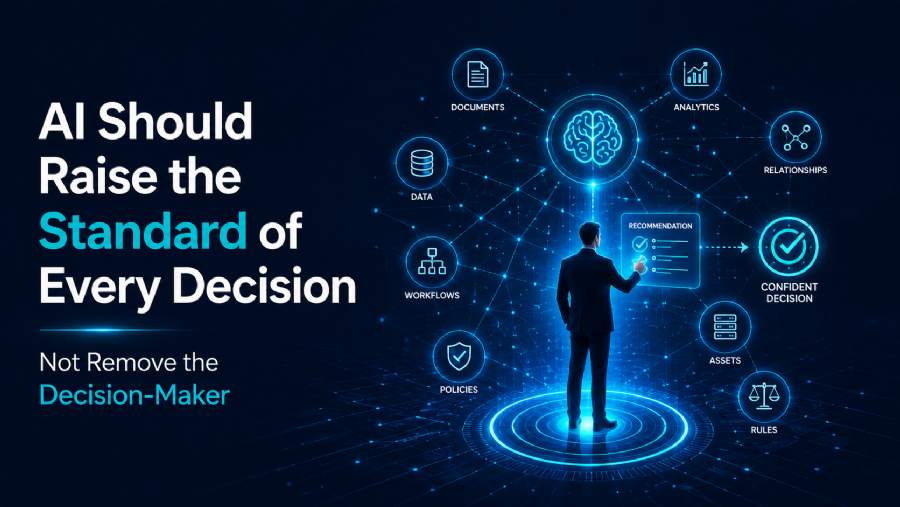
Why Geminos keeps people at the centre of AI-enabled decision-making
It is hardly surprising that employees are nervous about AI. Much of the public conversation still presents it as a contest between people and machines: if AI becomes more capable, fewer people will be needed.
That may make for a dramatic headline, but it is a poor way to think about most complex work—and an especially poor way to think about decision-making.
At Geminos, we start with a different question. Not, “How many people can AI replace?” but:
How can we help more people make decisions with the speed, context and judgment of an organisation’s very best?
The objective is not to remove people from the process. It is to make good decision-making more consistent and more widely available.
Making best practice available to everyone
Every organisation has people who seem unusually good at making difficult calls. They know where to look for evidence. They understand how one part of the business affects another. They recognise when a familiar pattern has a different underlying cause. They know which assumptions to challenge and when the data does not tell the whole story.
The problem is that this expertise is difficult to scale. It may be scattered across systems, documents and teams, or held in the heads of a small number of experienced employees. Those people also have limited time. They cannot personally review every incident, investigation, forecast or operational decision.
Geminos helps bring that knowledge together. At its heart is an enterprise knowledge graph that connects relevant data, documents, events, people and assets while preserving the relationships and business meaning that subject-matter experts understand instinctively. Instead of leaving expertise buried in documents or dependent on knowing whom to ask, the knowledge graph makes that context available whenever a decision is being made.
Business rules capture another important part of that expertise: established policies, operating limits, escalation thresholds, approval requirements and proven ways of handling particular circumstances. Subject-matter experts help define and refine those rules, turning best practice into a repeatable decision framework without pretending that every situation can be reduced to a rigid process.
The platform then uses causal models to examine how the important factors influence one another. AI helps interpret large volumes of information, identify relevant evidence, surface inconsistencies and suggest possible explanations or actions. The knowledge graph supplies context, the business rules establish relevant constraints, and the causal models help explain what is driving the outcome.
But it does not make the final decision.
Before a recommendation becomes a business decision, the person responsible reviews the relevant evidence, challenges the assumptions, adds context that is not yet captured in the data, and accepts, modifies or rejects it. The platform supports human judgment; it does not attempt to eliminate it.
This matters most when decisions are complex, consequences are significant, or circumstances are changing. In those situations, a plausible answer is not enough. People need to understand what the answer is based on, what may be missing and how confident they should be.
Human in the loop is a design principle
“Human in the loop” is sometimes described as a temporary safeguard that will become unnecessary as AI improves. We see it differently. For important decisions, human involvement is part of the operating model.
The division of labour is straightforward:
- AI handles scale. It can read and connect far more information than a person could examine in the available time.
- Knowledge graphs and business rules capture expertise. They make organisational context, policies and proven practices consistently available across the workforce.
- Causal models provide structure. They help distinguish a useful explanation from a pattern that happens to correlate with the outcome.
- People provide judgment. They understand goals, trade-offs, exceptions, ethical considerations and the current operational context.
- People remain accountable. A recommendation does not become a business decision until an authorised person has reviewed it and chosen what to do.
This is more than placing an approval button after an AI-generated answer. Human expertise helps define the problem, build the knowledge graph, shape the model, establish the business rules and determine what good evidence looks like. It is then used again to evaluate the result and decide whether action is justified. As the business changes, subject-matter experts remain responsible for refining the captured knowledge and best practices.
AI can narrow the experience gap
There is growing evidence that AI can be particularly valuable when it spreads the practices of top performers across a wider workforce.
A large workplace study published in The Quarterly Journal of Economics examined AI assistance used by 5,179 customer-support agents. Access to AI-generated suggestions increased productivity by 15% overall, with the largest gains among less experienced employees. Agents with only two months of experience and AI assistance performed as well as—or better than—agents with more than six months of experience who did not have it.
That is close to the opportunity we see at Geminos: not replacing the expert, but making more of the expert’s knowledge and decision discipline available to everyone else.
The same study also offers an important warning. The most skilled employees gained little, and on some quality measures their performance declined slightly when they followed AI suggestions too readily. AI can spread good practice, but it can also encourage over-reliance. The user must remain willing and able to challenge it.
Human judgment is not a weakness that has to be engineered out of the system. It is what prevents assistance from becoming autopilot.
The cost of treating AI as a direct substitute for people
Some organisations moved quickly from early AI productivity claims to headcount reductions. A growing number are now discovering that automating tasks is not the same as replacing a complete role.
Robert Half reported in 2026 that 32% of US hiring managers who eliminated positions after implementing AI later had to add the same or very similar roles back. Robert Half also found that 54% of executives expected AI to lead to job growth rather than contraction over the following two years.
Gartner reached a similar conclusion in customer service. It predicts that, by 2027, half of the companies that attributed headcount reductions to AI will rehire people to perform similar functions, although often under different job titles. Its survey of 321 customer-service leaders found that only 20% had actually reduced agent staffing because of AI; most were keeping headcount stable while serving more customers.
The course corrections are already visible:
- Klarna became one of the most prominent examples of AI-led efficiency after saying its customer-service assistant could perform work equivalent to 700 representatives. It later resumed recruiting human customer-service specialists after concluding that an excessive focus on cost had reduced quality. Klarna did not abandon AI—the technology continued to handle a large share of enquiries—but it made sure customers could still reach a person when they wanted one.
- Commonwealth Bank of Australia announced that 45 customer-service roles were redundant following the introduction of an AI voice bot. Within weeks, it reversed the decision, apologised to the affected employees and acknowledged that it had not considered all the relevant business factors. Reported call volumes had increased rather than fallen.
These examples do not show that AI has failed. They show that the replacement model was too simplistic. AI is often excellent at parts of a job, particularly high-volume and repeatable tasks. A role, however, also contains context, relationships, exception handling, accountability and judgment.
Better work, completed faster
It would be unrealistic to claim that AI will never change roles or eliminate tasks. It will do both. But a task is not a job, and a productivity gain does not have to become a redundancy.
It can instead mean that:
- an operations team investigates every significant incident rather than only the most urgent;
- an analyst spends less time gathering information and more time testing explanations;
- a newer employee benefits from years of accumulated organisational knowledge;
- an expert can focus on exceptional and high-consequence cases instead of repeatedly answering routine questions;
- decisions are made sooner, with more consistent use of the available evidence.
That is how Geminos measures the opportunity. Success is not an AI system making more decisions by itself. It is people making better decisions, faster—and an organisation able to reproduce the quality of its best decision-makers far more consistently.
AI should not take human judgment out of the loop. It should make that judgment better informed, better supported and more effective.